.png)
How to Match Car Paint Color Perfectly: A 2026 Guide
Table of Contents
Step 1: Finding Your Vehicle Paint Code
Locating the OEM Paint Code on Your Vehicle
Using a VIN Decoder to Confirm Your Paint Code
Step 2: Understanding Auto Paint Color Matching Services
The Realistic Equipment Ladder
What the Money Actually Buys
A Common Mistake: Assuming Code-Matched Means Color-Matched
When DIY Stops Making Sense
The Diagnostic Value of a Second Reading
Step 3: How Spectrophotometer Paint Matching Works
The Role of Primer Color in Matching
Step 4: Accounting for Sun Fade and Environmental Impact
Why UV Degrades Some Pigments Faster Than Others
The Clear Coat Is Usually the First Failure
What Actually Causes Color Shift Beyond UV
How to Adjust Your Expectations Before You Mix
Step 5: Mastering Automotive Paint Blending Techniques
Testing Paint on Sample Cards
Step 6: Troubleshooting Mismatched Results
Frequently Asked Questions
Last Updated: September 16, 2026
Step 1: Finding Your Vehicle Paint Code
Matching car paint color perfectly starts with finding the code your manufacturer used.
Locating the OEM Paint Code on Your Vehicle
The OEM paint code is the manufacturer's factory identifier for your vehicle's original finish, usually a short alphanumeric string found in a few predictable places:
The VIN plate or compliance label on the driver's door jamb
A service parts identification sticker in the glovebox, trunk, or spare tire well
The firewall or strut tower on older models
The owner's manual or a dealer-provided build sheet
Pro Tip On many vehicles, the paint code sits inside a larger block of build codes. Look for a two-part code (letters plus numbers) rather than a single letter, which is often a trim or interior code.
Using a VIN Decoder to Confirm Your Paint Code
A VIN decoder cross-references your 17-character vehicle identification number against manufacturer build data, confirming the door label and catching non-factory resprays. But decoders are useful, not infallible: some return only the base color family, not the exact variant, and manufacturers often run several shades under one name. Treat it as a second opinion.
Step 2: Understanding Auto Paint Color Matching Services
Auto paint color matching services combine your factory code with a physical reading of the actual panel, because the code alone tells you what the car left the factory with, not what it looks like today. That distinction is where most DIY attempts fail, and "DIY versus professional" is not one decision but a ladder, each rung buying a specific amount of accuracy for a specific amount of money and skill.
The Realistic Equipment Ladder
Tier 1, Pre-mixed touch-up pen or vial (roughly $15-$40). Matched to your factory code, with no measurement of your actual panel. Works on small chips in low-visibility areas, door edges, rocker panels, inside jambs. On a faded horizontal panel or any metallic finish, it reads as a visible dot, a concealment tool, not a color-matching tool.
What the Money Actually Buys
The jump from Tier 2 to Tier 3 is the biggest single improvement in outcome, and it costs the least. Tier 3 to Tier 4 buys consistency more than accuracy, a skilled hand-tinter can match a simple solid color as well as a scanner, but the scanner gets there faster and repeats the result on the next panel.
A Common Mistake: Assuming Code-Matched Means Color-Matched
A code-matched aerosol will not blend invisibly on a horizontal surface like a hood. Horizontal panels take the most sun, so their pigment density and surface oxidation rarely match a fresh can. The same logic applies to any panel that has lived a different life than the one you are spraying.
Pro Tip If you are deciding between tiers, ask one question first: is the panel I am repairing a horizontal surface, and is the vehicle more than five years old? If the answer to both is yes, Tier 1 and Tier 2 are off the table. Move up to at least Tier 3, or hand the job to a shop.
When DIY Stops Making Sense
The honest cutoff is about finish type and panel location, not the price of the car:
Solid colors, vertical panels, older vehicles: DIY at Tier 3 is realistic and often produces a result a casual observer cannot spot.
Metallics and pearls, any panel: flake orientation makes DIY matching unreliable without a spray gun and practice. Tier 4 or a shop is the realistic path.
Tri-coat finishes (a base, a mid-coat pearl, and a clear): effectively out of reach for DIY, the mid-coat carries the color shift, and getting it uniform by hand is a skill measured in years.
Any panel adjacent to a large, visible surface: blending is required, and blending is a technique, not a product. If you have not blended before, the first attempt will show.
The Diagnostic Value of a Second Reading
One underrated reason to use a shop even when you plan to spray yourself: a second reading. If your DIY formula comes out wrong, a shop with a spectrophotometer and color matching software can compare its reading against the manufacturer's documented formula and isolate whether the deviation is in the color, the primer, or the spray technique, telling you what to change on the next attempt instead of guessing again.
Key Takeaway DIY matching is not a single option, it is a ladder from a $15 pen to a $5,000 scanner, and the biggest quality jump sits at the cheapest rung (spray-out cards and hand tinting). The equipment tier you need is set by two variables: whether the finish is metallic or pearl, and whether the panel is horizontal. Get those two answers right and the rest of the decision follows.
Step 3: How Spectrophotometer Paint Matching Works
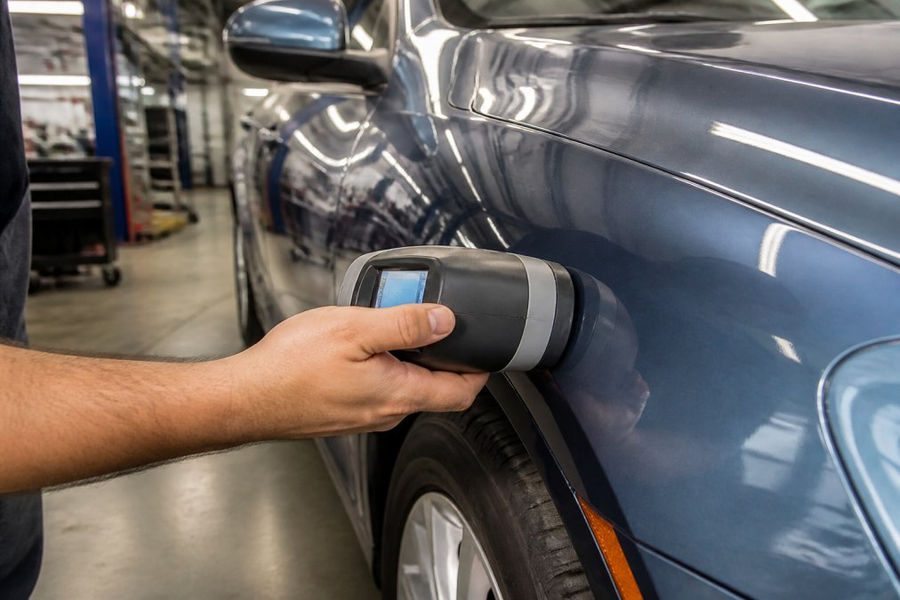
A spectrophotometer paint matching device reads the light reflected off your vehicle's finish and converts it into a numeric color formula. It measures across multiple wavelengths, which separates it from the human eye. The eye averages; the instrument does not.
The Role of Primer Color in Matching
Primer shade changes the final color, particularly on lighter and mid-tone finishes. A gray primer under a white base coat reads darker than a white primer under the same coat, because base coat coverage is rarely fully opaque.
Step 4: Accounting for Sun Fade and Environmental Impact
Sun fade is the single largest source of color mismatch on older vehicles, and it is not uniform. A car parked outdoors for years will have a hood and roof noticeably lighter than the doors, which sat in shade. Matching to the factory code alone produces a panel that looks correct next to a new car and wrong next to yours.
Why UV Degrades Some Pigments Faster Than Others
Automotive color comes from two broad pigment families, and they fail at very different rates under ultraviolet exposure.
The Clear Coat Is Usually the First Failure
Before pigment breaks down, the clear coat on top of it does. Modern clear coats are urethane-based with UV absorbers, but those absorbers are sacrificial, once depleted, UV reaches the base coat directly.
It scatters light at the surface instead of transmitting it cleanly, which lightens and desaturates the perceived color.
It changes the gloss of the panel, and gloss affects how a spectrophotometer and the human eye both interpret the reading.
What Actually Causes Color Shift Beyond UV
UV is the dominant factor, but it is not the only one:
Acid rain and industrial fallout etch the clear coat and leave mineral deposits that read as a color shift.
Road salt and brine, common in northern states during winter, attack clear coat edges and accelerate the failure described above.
Repeated temperature cycling causes the clear coat and base coat to expand and contract at slightly different rates, micro-cracking the interface and letting UV penetrate deeper.
Bird droppings, tree sap, and bug residue are acidic and etch permanently if left on the surface.
How to Adjust Your Expectations Before You Mix
A practical rule most experienced painters follow: on a vehicle more than five to seven years old that has lived outdoors, assume the horizontal surfaces (hood, roof, trunk lid) have shifted measurably from the factory formula, and the vertical surfaces (doors, fenders) have shifted less. On a garage-kept vehicle, the gap is much smaller.
That means:
If you are repairing a door or fender, a code-matched formula plus a spectrophotometer reading of that specific panel is usually enough.
If you are repairing a hood or roof, expect to need a custom tint adjustment, and expect the adjacent panels to look slightly different no matter how good the match is, because they genuinely are a different color now.
If the vehicle is red, orange, or yellow, budget extra time for tinting. These are the colors most likely to require a hand-adjusted formula.
Watch Out Never scan a panel that hasn't been cleaned and decontaminated. Road film and wax residue skew the reading, and the resulting formula will be off before you ever open a can. On a heavily oxidized panel, polish first, then scan, the reading you get off chalky clear coat is not the reading you want to match.
Key Takeaway The factory code tells you what the car was. The chemistry of UV exposure tells you what it is. Reds and yellows drift toward lighter, warmer tones as organic pigments break down; whites and silvers mostly dull as the clear coat fails. Knowing which category your color falls into tells you how much tinting work to expect before you mix a single ounce.
Step 5: Mastering Automotive Paint Blending Techniques
Automotive paint blending techniques exist because no formula is a perfect match across an entire vehicle. Instead of painting one panel edge-to-edge, you fade the new finish into the adjacent original paint, hiding the transition in a way a hard panel edge never can.
The process, in order:
Clean and scuff the repair area and the blend zone
Apply primer matched to the factory shade
Lay the base coat in thin, even passes
Extend each pass slightly into the blend zone
Apply clear coat across the full blended area
Allow full curing time before polishing
Testing Paint on Sample Cards
Spray-out cards let you verify the formula before it touches the car. Spray a test card, let it cure, then hold it against the panel in direct sunlight and in shade. Metamerism, where two colors match under one light source and diverge under another, shows up here and nowhere else.
Step 6: Troubleshooting Mismatched Results
When a repair still doesn't match, the cause is usually one of five things, and each has a specific fix.
Symptom | Likely Cause | Fix |
Color too light | Wrong primer shade | Reshoot with matched primer |
Color too dark | Excess base coat passes | Reduce coats, re-blend |
Metallic looks off | Flake orientation | Adjust spray distance and angle |
Visible panel edge | Blend zone too narrow | Widen the fade area |
Matches in shop, not outside | Metamerism | Re-scan under natural light |
Frequently Asked Questions
How can I match my car's paint color?
Start by finding your vehicle's OEM paint code, usually on the driver's side door jamb or under the hood. Then use a VIN decoder to confirm the code. For a precise match, visit a professional shop that uses a spectrophotometer to scan the paint and account for sun fade. Always test the paint on a spray-out card before applying it to your car.
What is the hardest paint color to match on a car?
Metallic and pearlescent finishes, especially silver and gold, are the hardest to match because their appearance changes with lighting and viewing angle (metamerism). The metallic flakes must be oriented correctly during application. Tri-coat paints, which have a tinted mid-coat, also present challenges. Professional blending techniques and a spectrophotometer are essential for these colors.
Does sun exposure affect how car paint matches?
Yes, sun exposure causes paint to fade and oxidize, shifting its color over time. Even if you use the exact OEM code, new paint may not match the faded original. A spectrophotometer scan can measure the current color and adjust the formula. Blending the new paint into adjacent panels helps disguise any remaining difference.
Why does my touch-up paint look different than the original?
Touch-up paint often looks different because it lacks the clear coat and may not account for sun fade. The applicator can also apply it unevenly, and metallic flakes may not align properly. For best results, use a spray-out card to test the color, apply thin coats, and finish with a clear coat. If the mismatch persists, consult a professional for blending.
Free Estimate


Comments